A research survey / Carnegie Mellon University

Beyond Natural-Language
Interfaces

Decisions, Scores, and Predictive Distributions

What should a language model report when another system
needs to make a decision?

Yubo Li · Ramayya Krishnan · Rema Padman

D
Decisions
Which option?
S
Scores
How does it rate?
V
Numerical estimates
What value?
P
Predictive uncertainty
What uncertainty?

Schematic report roles. Text generation may still occur inside the producer.

01 / Perspective

An interface is an
information choice.

Language models increasingly supply the predictions on which other systems act. The important question is what a report means—and whether it supports the decision that follows.

We connect classification, reward and quality scoring, numerical prediction, and probabilistic forecasting through three questions.

  1. 01

    What is the target?

    A ranking score, an outcome probability, and a teacher’s quantile make different claims.

  2. 02

    What survives the transformation?

    Preserving order, enforcing a constraint, and improving task performance are different achievements.

  3. 03

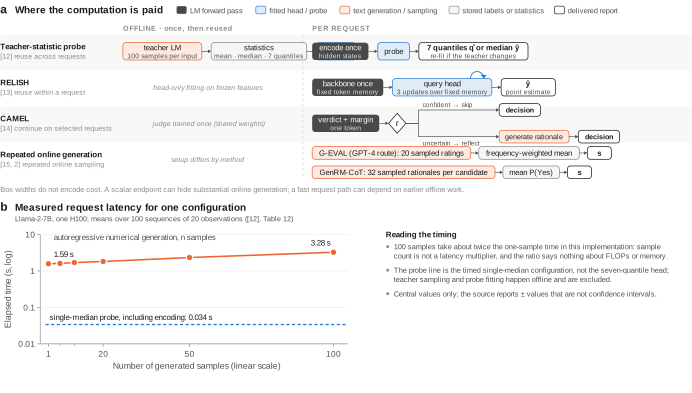
    Where is the computation?

    A compact report may require repeated generation—or reuse work done earlier.
02 / The taxonomy

Different reports.
Different commitments.

Follow what reaches the consumer, then how it is produced. These roles can overlap: one system may expose quantiles, a median, and a thresholded decision.

DWhich option?

Decisions

A selected class, candidate, route, or action under a specified rule.

Representative routes
  • Candidate-token readouts
  • Joint classifiers & routers

Select a model before an answer is generated.

SHow does it rate?

Scores

Values used to compare, rank, or threshold candidates against a criterion.

Representative routes
  • Likelihood-based scoring
  • Ratings & reward readouts

Rank candidate responses by reward.

VWhat value?

Numerical estimates

A point or numerical property defined by a target, units, and loss.

Representative routes
  • Scalar or iterative heads
  • Sample-based statistics

Predict a median price for absolute error.

PWhat uncertainty?

Distributions & summaries

A predictive law, samples, or specified uncertainty summaries for a named target.

Representative routes
  • Numerical-bin distributions
  • Quantile heads & probes

Retain price quantiles for a tail-sensitive decision.

C

Structured composition

A cross-cutting boundary: combine local reports into spans, fields, or constrained assignments.

Across the four roles

Finite quantiles do not specify a full density. A teacher’s generation process and observed outcomes are different prediction targets.

Taxonomy in the paper
View the full taxonomy
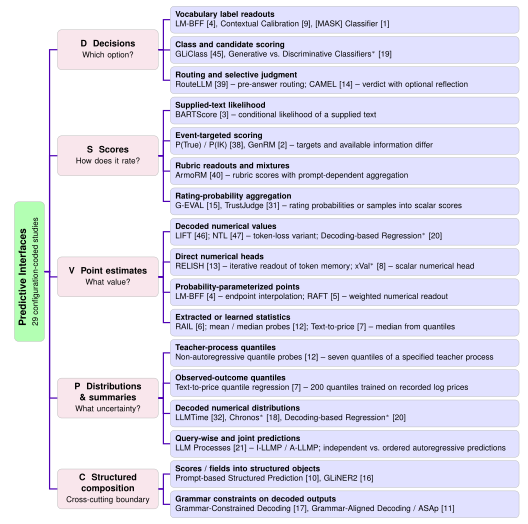
Full taxonomy of decisions, scores, numerical estimates, distributions, and structured composition, with the seventeen production mechanisms and representative papers.
Figure 2 from the survey. Branches group report roles and mechanisms; they do not imply execution order or a ranking. Open at full size ↗
03 / Evidence, with context

Look past the output.

Concrete comparisons reveal what a report’s format alone cannot tell us.

The metric can reverse the verdict.

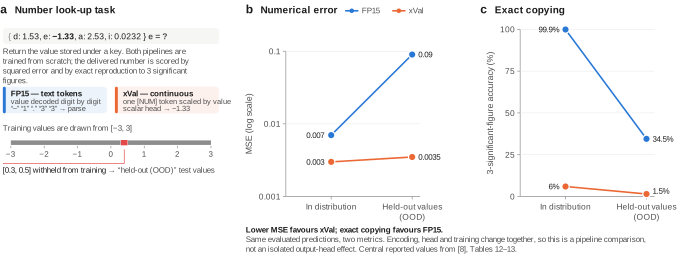
On held-out values in a number look-up task, xVal achieves lower numerical error (MSE 0.0035 vs. 0.09), while FP15 more often reproduces the value to three significant figures (34.5% vs. 1.5%). The same evaluated predictions support different rankings.

Open figure
Number look-up comparison: xVal has lower MSE than FP15 on both in-distribution and held-out values; FP15 has higher exact reproduction accuracy. The source figure shows the full in-distribution and held-out comparisons.
What this establishes The preferred interface depends on the error that matters. Both models train from scratch; encoding, head, and training change together. This is a pipeline comparison, not an isolated output-head effect. Figure 4, with sources and caveats ↗
04 / A practical guide

Start with the consumer.

Retain the information needed for today’s decision—and for the changes you expect to make later.

Scroll table to compare

A condensed selection guide based on Table 8 and Appendix D of the survey.
The consumer needs to…Useful reportWhat must be checked
Select, route,
or abstain
A final decision, or a score with a validated rule.Fix candidates, costs, and thresholds. A margin is not automatically a correctness probability.
Rank or combine
candidates
Comparable scores; retain component values if weights may change.Ordering alone does not validate probability claims or weighted sums. Preserve rubric identities and scales.
Predict a numberA loss-matched point: a mean, median, or specified quantile.Match the target and units. Squared error calls for a mean; absolute error admits a median.
Answer uncertainty
or changing-loss queries
Required quantiles, a predictive law, or adequate retained samples.Name the prediction target. Teacher uncertainty differs from outcome uncertainty; joint events need dependence information.
Return a valid
structured object
A completed object, or local reports plus constraints.Check legality and semantic quality separately. Include solver, parser, and assembly costs.

A guide to information requirements, not a ranking of estimators. Richer reports need not be more accurate or cheaper to estimate.

Full selection guide
Looking forward

When losses, constraints, or teacher processes change,
what must be revalidated?

Read the research agenda
05 / Paper & resources

The complete survey.

The full taxonomy, configuration-level comparisons, statistical foundations, and evidence-linked selection guide.

Survey manuscript · 59 pages · 21 September 2026

Cite this work

@unpublished{li2026beyond,
  title = {Beyond Natural-Language Interfaces:
    Decisions, Scores, and Predictive Distributions},
  author = {Li, Yubo and Krishnan, Ramayya and
    Padman, Rema},
  year = {2026},
  note = {Survey manuscript},
  url = {https://yubol-bobo.github.io/beyond-nl-survey/}
}

Acknowledgments

This research was supported in part by the National Institute of Standards and Technology under Federal Award ID 60NANB24D231 and by Carnegie Mellon University’s AI Measurement Science and Engineering Center (AIMSEC). We also gratefully acknowledge support from OpenAI’s Researcher Access Program, which provided API credits used in this research.